Custom Web/Solutions · 2026
Loop Deco — Reverse Logistics Operations Platform
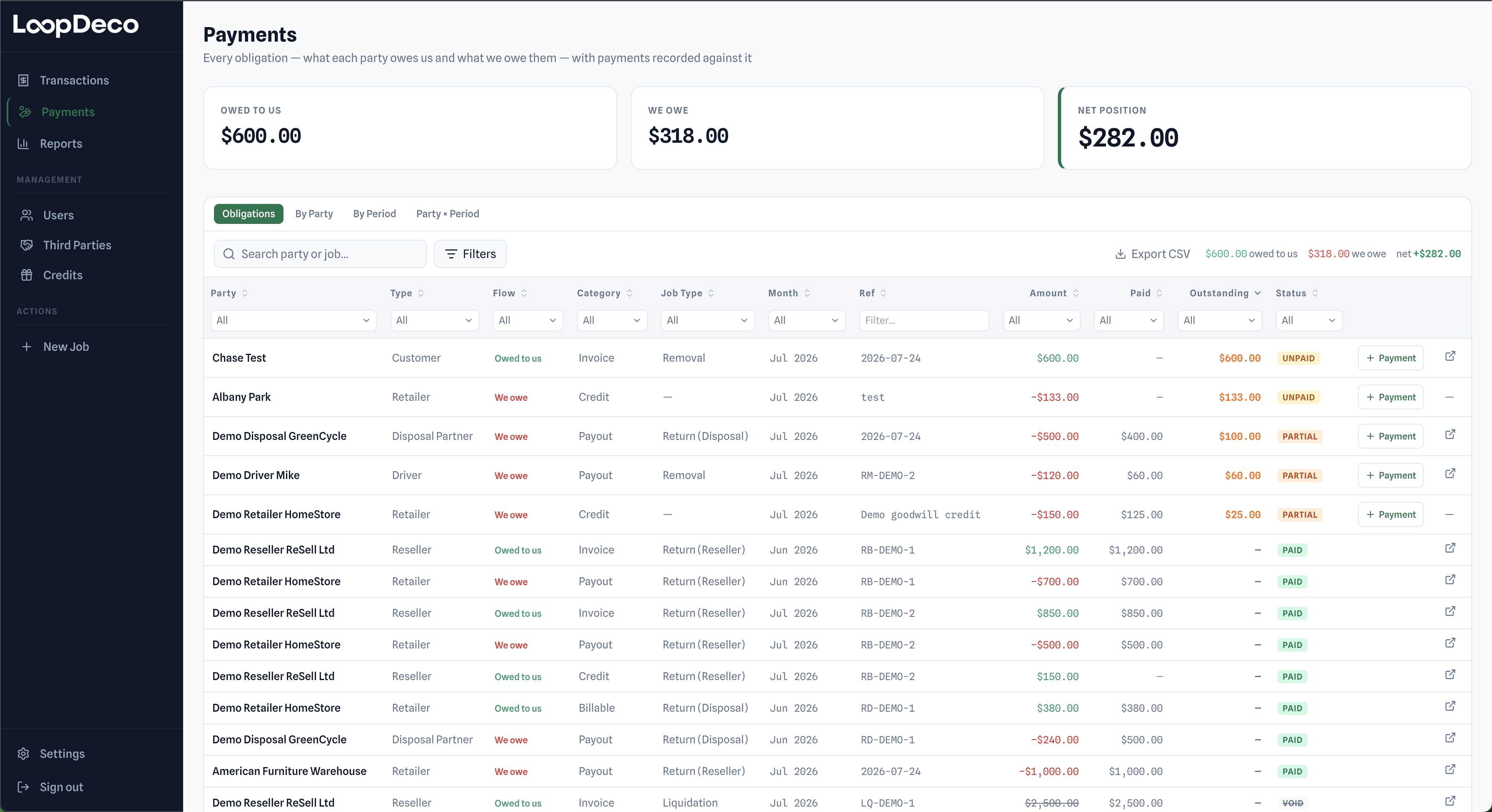
Loop Deco's operations team tracked every removal, return, and liquidation job in a single Excel file that got emailed around and edited by whoever had it open — no accounts, no real database, and no way for two people to safely work on it at once. I rebuilt it as a proper multi-user web application with real logins, structured workflows per job type, and a credit ledger tracking what's owed between every retailer, reseller, disposal partner, and driver involved.
Replaced a single manually-shared Excel file with a real multi-user system
Role
Full Stack Developer — sole engineer, migrated the client off a manual spreadsheet workflow.
Outcomes
~20–30 hrs/month
Manual reconciliation saved
4
Job types now tracked in one system
Eliminated
Single-file, single-editor bottleneck
The Problem
Every job — removal, return-to-reseller, return-to-disposal, or liquidation — lived as a row in one shared Excel file. Only one person could safely edit it at a time, there was no login or audit trail, and reconciling what was owed to or from each retailer, reseller, disposal partner, or driver meant manually cross-referencing rows across a growing spreadsheet. A single overwritten save could wipe out someone else's edits with no way to recover them.
What Was Built
- Four dedicated job workflows — removals, return-to-reseller, return-to-disposal, and liquidations — each mirroring how that job type actually gets processed
- Unified directory of retailers, resellers, disposal partners, drivers, and customers, replacing scattered spreadsheet tabs
- A credit ledger tracking directional balances owed between the company and every partner, tied back to the job that created them
- Admin dashboard with KPI summary cards and per-stream filtering across all four job types
- Real session-based authentication (bcrypt + signed JWT), replacing a spreadsheet anyone with the file could open and edit
Solution
I rebuilt the operation on Next.js with a Postgres backend, replacing the single Excel file with real tables for jobs, retailers, resellers, disposal partners, drivers, and customers. Each job type got its own guided workflow instead of a generic spreadsheet row, so the fields captured actually match how that job is processed on the ground. The credit ledger was the piece that mattered most to the client: instead of manually working out who owed whom after the fact, every credit is created directly from the job that generated it and tracked against the right party. Combined with real accounts and a proper database, the team can now work on the same data at the same time without stepping on each other — something the old spreadsheet simply couldn't support.
Tech Used
Have a similar problem?
I help startups and product teams build fast, scalable web applications and move manual operations into software. Let's talk about what you're working on.